A lighting scheme can give a perfectly readable desk and still say nothing about the light reaching people's eyes. When a brief mentions “human-centric lighting”, it needs a precise quantity, a measurement position and a time of day. That quantity is usually melanopic EDI. Here is what it means, in as plain words as the subject allows.
What melanopic EDI is
The eye has receptors that do not help us see but tell the body clock whether it is day or night. They are most sensitive to blue-green light. Melanopic EDI (equivalent daylight illuminance) expresses how strongly a given light acts on those receptors, as the lux of daylight that would have the same effect. It is not another name for ordinary lux. The measurement system is defined in CIE S 026.
How it relates to ordinary lux
A second number, melanopic DER, describes the spectrum: how “melanopically strong” a light is compared with daylight. For a known spectrum at a given position, melanopic EDI = ordinary lux at the eye × melanopic DER.
| Lux at the eye | DER (example spectrum) | Melanopic EDI |
|---|---|---|
| 200 lx | 0.50 (warm light) | 100 lx |
| 200 lx | 1.20 (cool, blue-rich light) | 240 lx |
These are illustrative numbers, not measurements of our lamps. They show the key point: the same lux can mean very different melanopic values. Colour reflected from walls changes the spectrum too, so data for the lamp alone is not always enough.
What 250, 10 and 1 mean
The consensus by Brown and colleagues (2022) recommends, for healthy adults aged 18 to 55 with daytime schedules: at least 250 lx melanopic EDI at the eye during the day, at most 10 lx in the three hours before sleep, and at most 1 lx during sleep. These numbers do not transfer automatically to children, older people or night shifts, and they do not replace visual comfort or safety requirements.
Why CCT and CRI are not enough
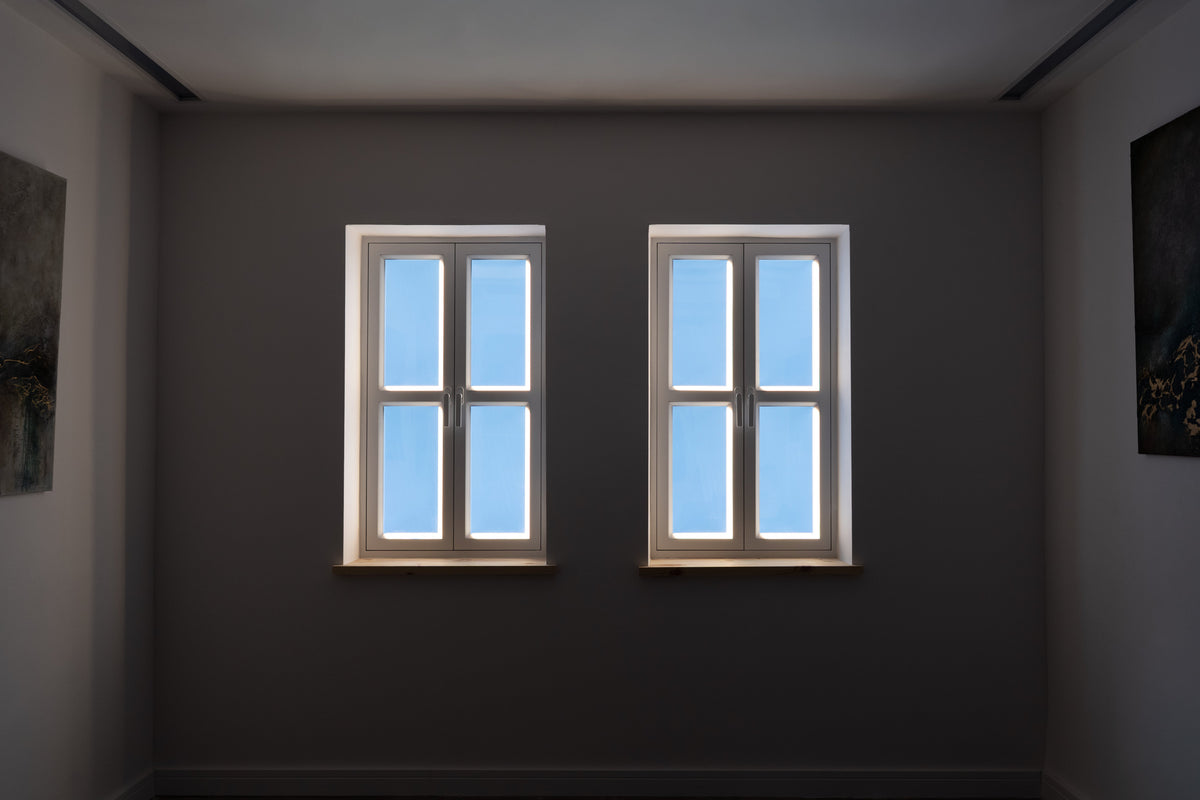
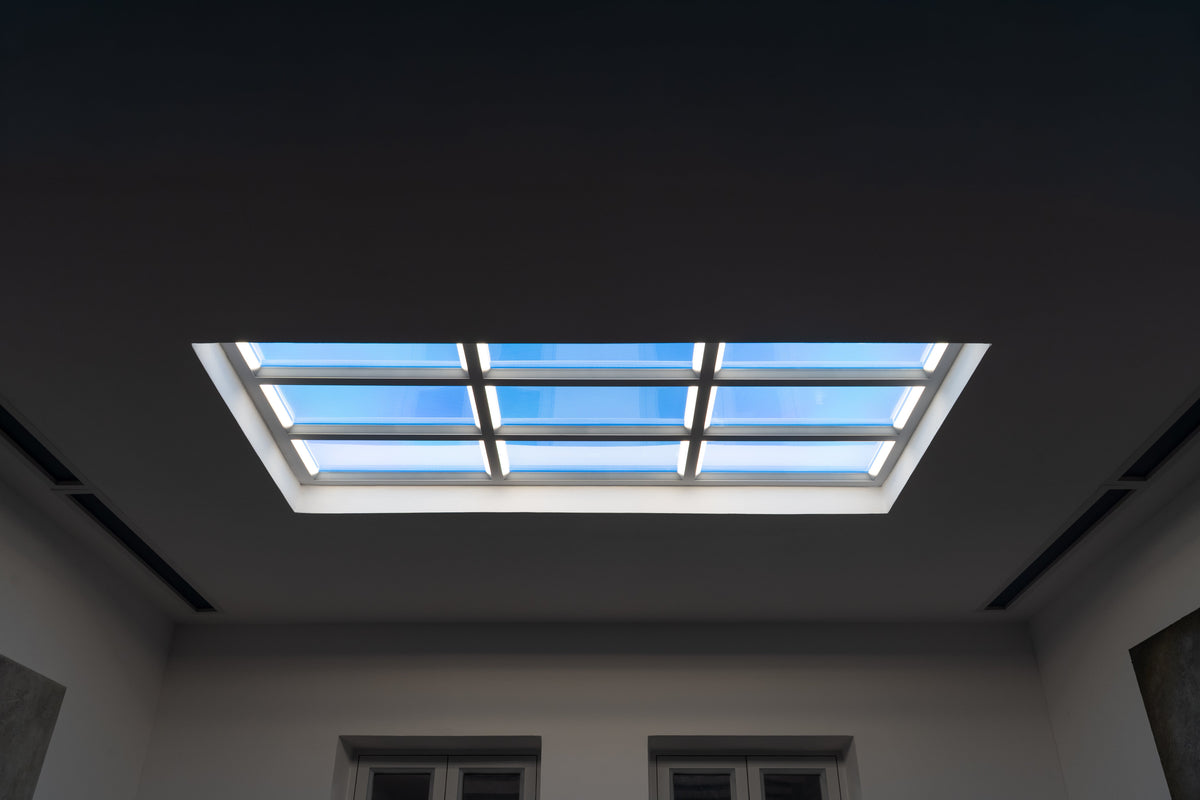
Colour temperature describes whether white looks warm or cool. CRI describes colour rendering. Neither tells you the full spectrum, so neither lets you work out DER. And a photo of a blue sky panel says nothing about exposure. What counts is how much light, of what spectrum, reaches the eyes at the real seat.
Plan the measurement
Write down the position, eye height, viewing direction, lamp settings, daylight contribution and how long the scene lasts. A horizontal reading on a desk answers a different question from a vertical reading at eye level. With several light sources, measure their combined effect at the position: DER values of separate lamps cannot simply be added.
What to ask us for
For a project, ask for the spectral data (SPD) of the exact model at the colour temperature and dimming level you plan to use, and how the driver is configured. Our FLAT and ZENITH tune from 2100 to 7500 K, so the spectrum changes with the setting, which is useful by day and in the evening. Our lamps are architectural lighting; we do not market them with health claims, and an exposure assessment for a project needs its own measurement.