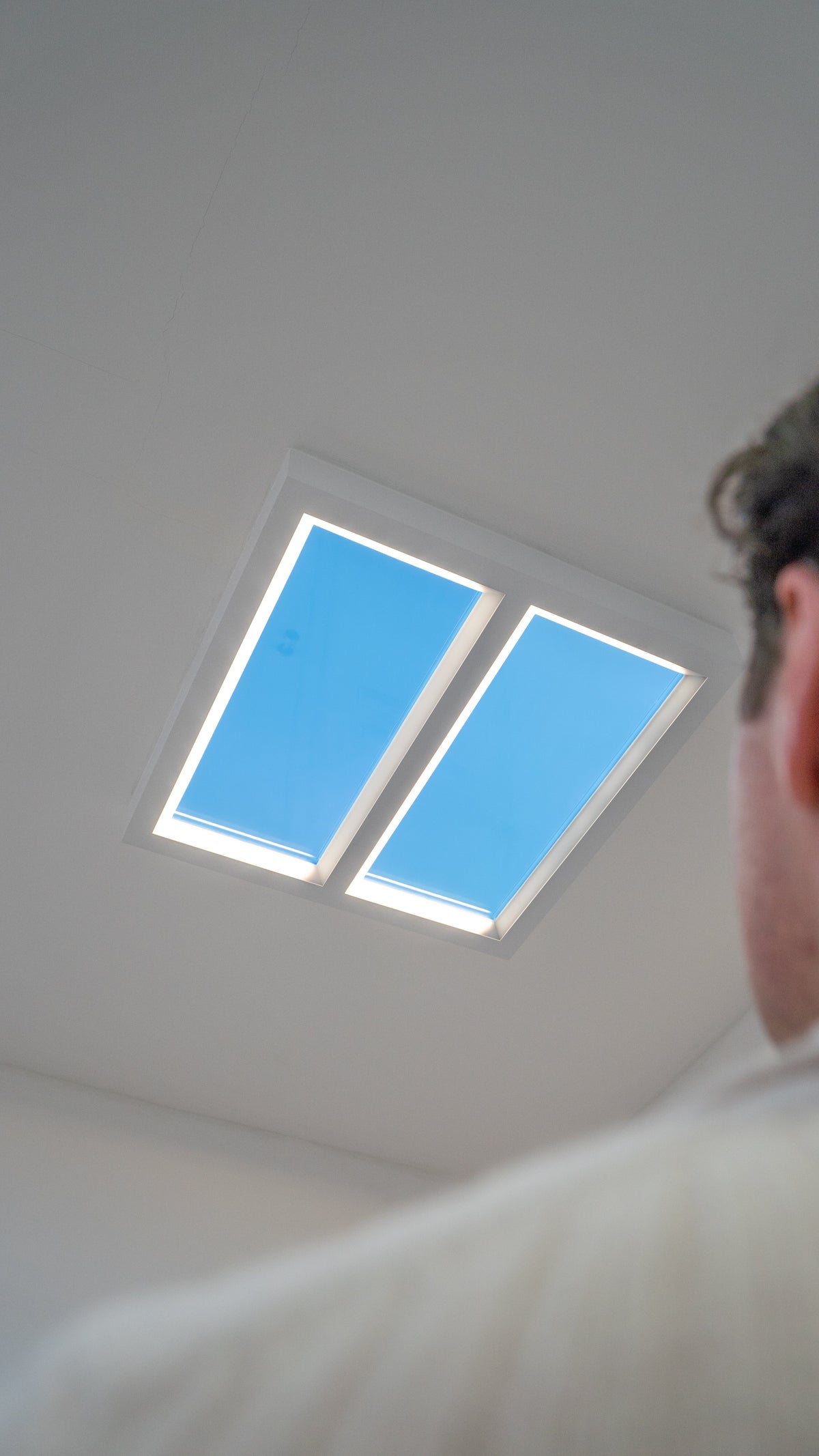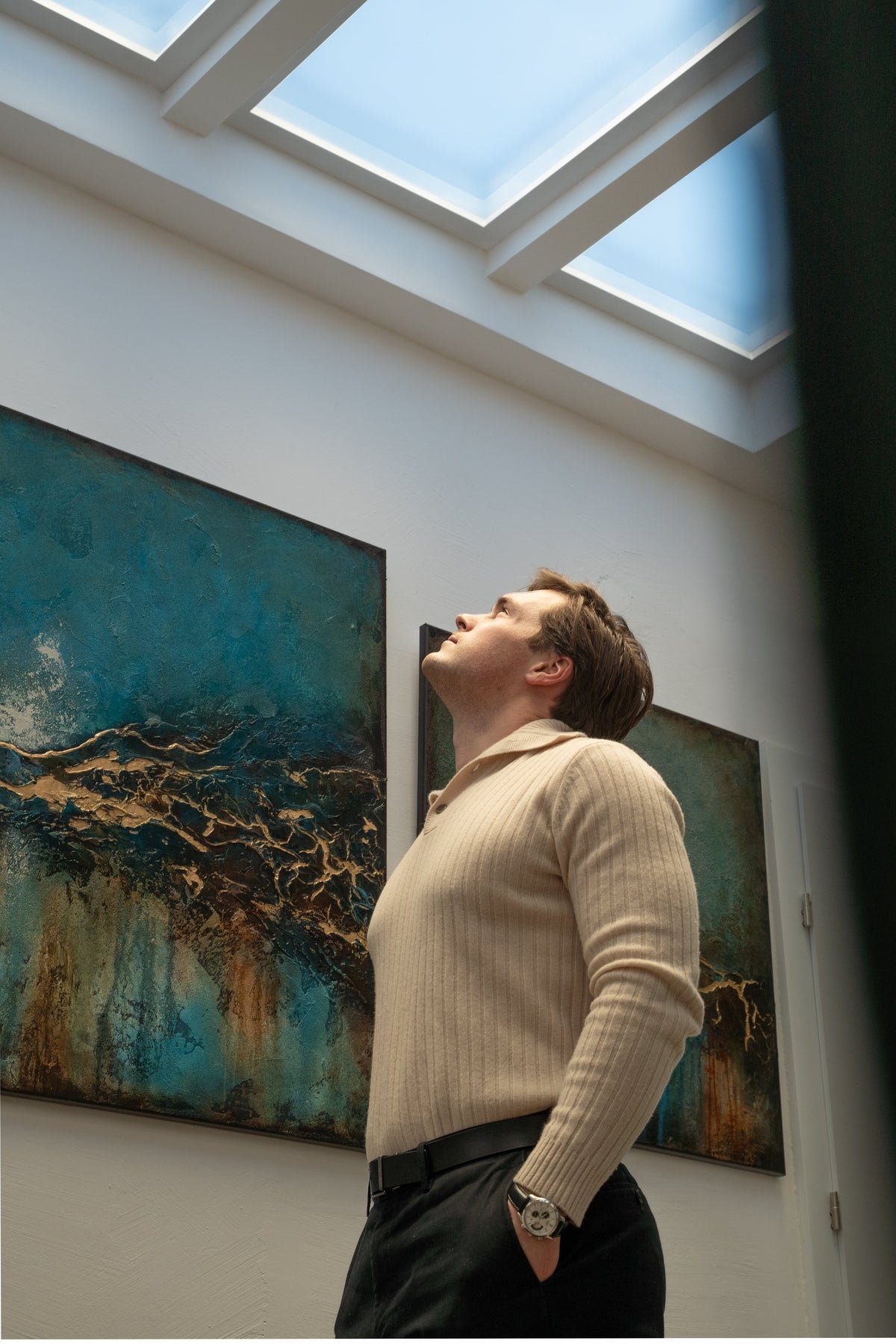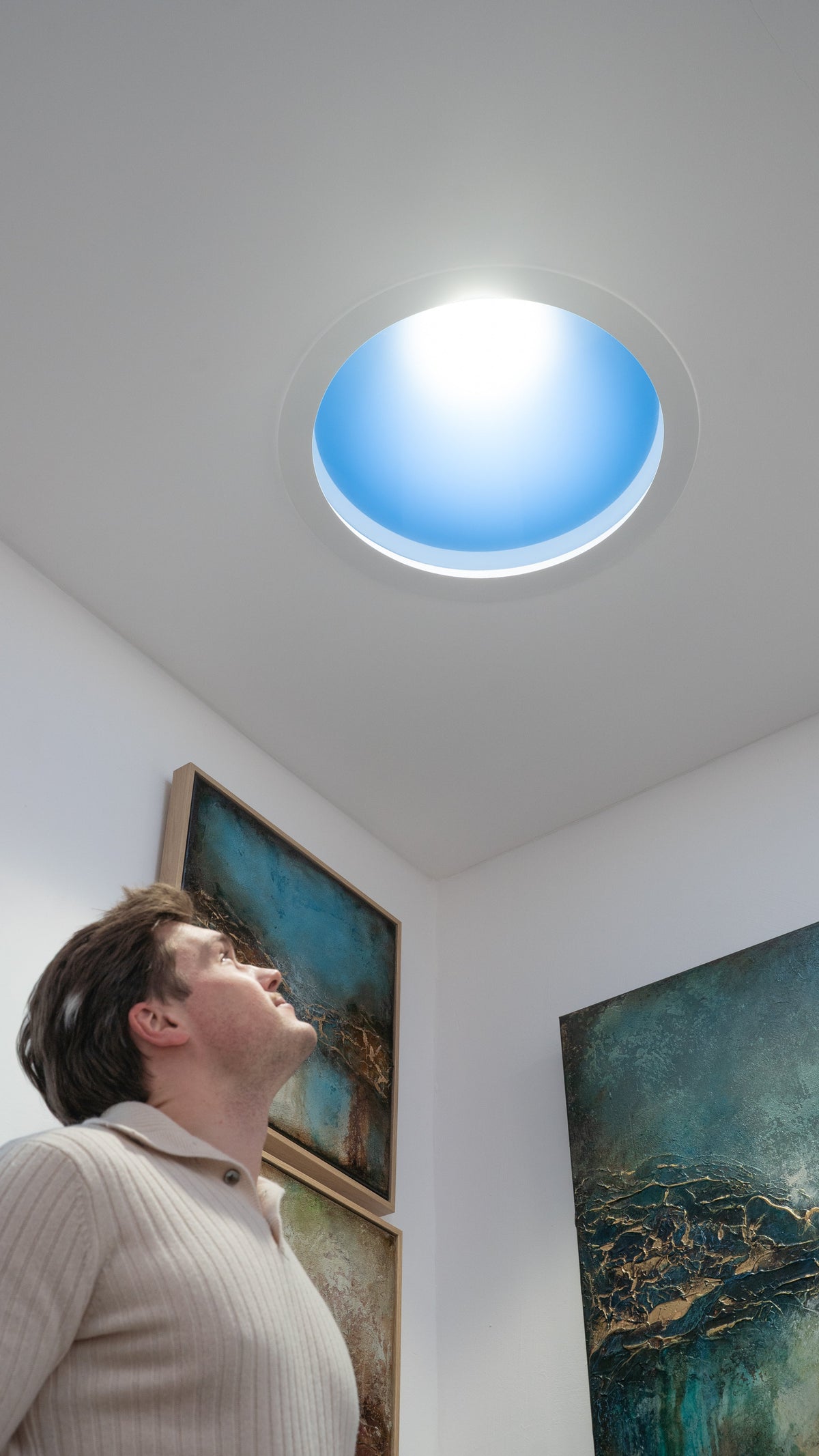
Two lamps can both say 5,000 lm and light a room completely differently. Our ZENITH 60 x 60 cm and the FOCUS-R300S both give 5,000 lumens. ZENITH sends its light in a 15° beam straight down and makes a bright pool below. The FOCUS-R300S shows a sun disc against the sky. Same number, different room.
That is because lumens, lux and luminance answer three different questions.
Three units, three questions
| Quantity | Unit | Question it answers |
|---|---|---|
| Luminous flux | lumen (lm) | How much light does the lamp give in total? |
| Illuminance | lux (lx) | How much light lands on a surface, such as the table? |
| Luminance | cd/m² | How bright does a surface look from where you are? |
These are simplified versions of the CIE definitions of luminous flux, illuminance and luminance.

When you read a product table, check what the lumens refer to. An LED module on its own and a complete lamp with its diffuser give different numbers. Ask any seller, us included, which one the figure means.
Why you cannot just divide lumens by the floor area
One lux is one lumen per square metre, but only for the light that actually reaches that surface. A lamp's lumens also go to the walls, the ceiling and the furniture, and some reach the table only after bouncing off a wall.
| Area | Light reaching it | Average |
|---|---|---|
| 4 m² | 2,000 lm | 500 lx |
| 10 m² | 2,000 lm | 200 lx |
That is the arithmetic of an average, assuming 2,000 lm really reach the surface. It does not mean every point gets the same, and it is not what a 2,000 lm lamp gives in a real room. For that you need the lamp's light distribution and the room geometry, or a measurement.
Same lamp, different measuring surfaces
For a desk you measure on the desk. For a painting, on the wall. For light reaching the eyes, at eye height, facing where the person looks. "500 lx measured" means nothing until you know where, at what height, at what setting, and whether daylight was coming in.
At handover, compare like with like. An evening reading under electric light and a midday one with the blinds open answer different questions.
Why the desk can be bright and the room still gloomy
How a room looks depends a lot on the walls, the ceiling and the lamps you can see. A small, very bright surface against a dark background gives strong contrast, and it looks different standing up and from a low sofa. Luminance helps explain this, even though it is a physical quantity and not the same as perceived brightness.
A simple model for a perfectly matt surface is L = ρ × E / π. At 200 lx on a wall that reflects 70% of the light, that gives about 44.6 cd/m². On a wall that reflects 10%, about 6.4 cd/m². Same light, a wall seven times darker. Gloss paint or a mirror behave differently, but the point stands: wall colour matters.
What this means for our lamps
| Series | How it sends light | Output |
|---|---|---|
| FLAT | 120°, across the whole room | 1,500-10,000 lm |
| ZENITH | 15° straight down | 5,000-15,000 lm |
| FOCUS | A sun disc and a concentrated beam | 5,000 lm (R300S), 20,000 lm (large models) |
| ACCENT | 30° onto the wall | 750-4,000 lm |
| LINEA | 30° onto the wall | 1,500 lm |
So before comparing lumens, decide where the light should fall, where people will see the lamp from, which surfaces surround it and how much space the whole installation can take. A directional lamp may need a different position relative to the desk than a diffuse one.
Which data to ask for
The exact model and configuration, the lumens of the complete lamp, the light distribution file (IES or LDT), the installation drawing and the driver details. If a file is not available, note that it is missing rather than borrowing a value from a similar lamp. Our drawings and data sheets are on the DWG and PDF files page; if you need a distribution file for a calculation, ask us for the specific model.
Colour is a separate question: CRI and colour temperature do not replace a light distribution. Our lamps have a CRI above 93. Effects on the body clock need spectral data and the light at the eye, and CIE S 026 is the framework for that.
Short answers
Will 5,000 lm be enough for my room?
It depends on the distribution, the mounting height, the surfaces and what you do in the room. Decide the effect and where you will measure first. Send us the plan through the contact page and we will suggest a starting point.
Can I work out how bright the panel looks from its lumens?
Not from lumens alone. You also need the size of the emitting surface and how the light leaves it.
What if there is no IES or LDT file?
Then a sample or a measurement in the room is the next best thing, and the missing file should stay visible in the decision. You can also compare our lamps by eye in the showroom at Taneczna 27 in Warsaw, open 24/7.